- a measurement acquired by a particle detector is a physics event

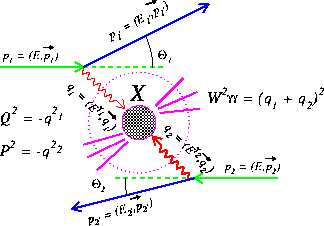
What does it have to happen to generate a physics event: the collision
- particles beam creation
- particle bunches collision, one per colliding beam
- inelastic interaction of at least one particle per bunch
- in case of protons, identification of two partons (according to the parton distribution functions)
- interaction of these elementary particles, in the perturbative regime
- proton remnant interaction, that generates the underlying event (UE)
- non-perturbative part of the interaction: showering and hadronization
- additional interactions generate pile-up (PU)
What does it have to happen to measure the physics event: the detection
- the products of the collision travel until they reach the detector (after crossing the beam pipe)
- charged particle trajectories are typically bent in a magnetic field
- some of the particles decay in flight
- particles interact with the detector, generating energy deposits
- the single sensing elements of the detectors transform this energy into electrical signals
What does it have to happen to observe the final event the reconstruction
- raw electrical signals are saved on disk or tape and, at the same time, processed by reconstruction algorithms
- in case of high-frequency events, only a fraction of them gets saved, after a choice performed synchronously with the data taking (trigger)
- electrical signals get analysed to reconstruct the number, type and kinematics of the particles that crossed the detector
- final objective: determine the parameters of a theory model
- obtained through the comparison of data to a model (fit)
- the simulation is the model used in the comparison, it is therefore a theory calculation performed with a sophisticated system of software tools
Solitamente suddivisa in diversi passaggi, che riproducono le fasi nelle quali abbiamo suddiviso l'evento fisico
Usually divided into various steps, that reproduce the ones in which the physics event was split.
| phase | description |
|---|---|
| elementary particles collision | perturbative calculation of the interaction |
| showering and hadronization | calculation of the non-perturbative part of the interaction |
| simulation (abuse of language) | radiation-matter interaction, until the energy deposit in the detector |
| PU addition | overlap to the first event of energy deposits due to PU events |
| digitisation | simulation of the data acquisition electronics response |
| trigger | simulation of the on-line selections |
| reconstruction | running of the reconstruction algorithms, usually the same ones used for real events |
- each phase described in the table is performed by dedicated computing programs
- the perturbative calculation of the interaction is usually performed by programs called matrix element Monte Carlo generators
- they calculate the differential probabilities that the interaction happens, i.e. differential cross-sections, starting from the matrix elements of the interaction built from the Lagrangian of the process of interest
- the cross sections are differential in the maximum number of variables, to fully describe the event: this is the full kinematics of each final state particle
- the integration of the differential cross-sections is performed with the Monte Carlo method: generating random numbers in the N-dimensional phase space of the final state differential distribution, and counting how many of the points lay below the function to be intergated
- practically, Monte Carlo programs produce sequences of points that lay under the curves to be integrated
- since the phase space is the total kinematics of the final state, each generated point may be assimilated to the simulation of the perturbative part of the collision
The points generated by Monte Carlo programs are usually called events
- they are not real events
- the non-perturbative part of the calculation is missing, both in the initial and final states (remember the factorisation theorem)
- the perturbative part is not known at all orders
- almost any collision process is known and simulated at tree level (leading order, LO)
- most of the processes observed so far are known and simulated at NLO QCD
- a handful of processes are known and simulated at NLO EWK
- there exist processes where the theory calculations
which are more precise than the event simulation
- some processes known at NNLO QCD, almost no one is simulated with such a precision
- one process (gluon fusion Higgs boson production) known at N3LO QCD, not simulated
- for some processes the NLO EW corrections are known
- NLO perturbative corrections add real and virtual terms to the total cross-section
- this reflects in the fact that not all simulated events have the same
importance for the cross-section calculation:
they acquire a weight
- they do not obey to Poisson statistics (measurements do)
- some events may acquire negative weight, that usually originates from the NLO virtual terms
Even if the physics event is not completely described by the product of the Monte Carlo event generator, their study is frequently useful.
- tight link between the outcome of the study and the perturbative part of the calculation helps in grasping the main physics effects in play
- generation of events is fast and requires little space
- non-perturbative effects are neglected, therefore all quantities that are affected by that are not meaningful
- no description of the resolution in the event reconstruction, either due to non-perturbative or detector effects
- instrumental backgrounds due to detector effects are not present (for example mis-identified jets as leptons)