


Disclaimer: This repo is not ready for production yet. I’m exploring where soft-real-time devices fit in automation and would like to develop this into a bachelor’s thesis. If you know a professor, or someone who could help me pursue that, feel free to reach out! :)
Pure-Elixir EtherCAT master built on OTP.
- No NIF.
- No kernel module.
- Nerves-first, runs on standard Linux too.
- Minimal runtime dependency surface.
- Best for discrete I/O, Beckhoff terminal stacks, diagnostics, and 1 ms to 10 ms cyclic loops.
- Not the right fit for sub-millisecond hard real-time control.
The entry idea is simple: the master owns the session lifecycle, domains own cyclic LRW exchange, slaves own ESM and slave-local configuration, and DC owns clock discipline. Critical domain/DC runtime faults move the public state to :recovering; slave-local faults are tracked separately so healthy cyclic parts can stay up.
Runtime footprint is intentionally small: no NIFs, no kernel module, and only a
minimal runtime dependency surface. The library talks to Linux directly through
raw sockets, sysfs, and OTP, with :telemetry as the only runtime Hex
dependency.
Latest Hex release:
def deps do
  [{:ethercat, "~> 0.3.0"}]
end
For release notes and post-0.3.0 work, see CHANGELOG.md.
If you want the current main branch instead of the latest Hex cut:
def deps do
  [{:ethercat, github: "sid2baker/ethercat", branch: "main"}]
end
Raw Ethernet socket access requires CAP_NET_RAW or root:
sudo setcap cap_net_raw+ep _build/dev/lib/ethercat/priv/raw_socketLink monitoring is handled internally.
EtherCAT.start(interface: "eth0")

:ok = EtherCAT.await_running()

EtherCAT.state()
#=> :preop_ready

EtherCAT.slaves()
#=> [
#=>   %{name: :slave_0, station: 0x1000, server: {:via, Registry, ...}, pid: #PID<...>},
#=>   ...
#=> ]

EtherCAT.stop()
If you start without explicit slave configs, EtherCAT still scans the ring, names each
station, and brings every slave to :preop. That is the right entry point for
exploration, diagnostics, and dynamic configuration.
defmodule MyApp.EL1809 do
  @behaviour EtherCAT.Slave.Driver

  @impl true
  def signal_model(_config), do: [ch1: 0x1A00]

  @impl true
  def encode_signal(_signal, _config, _value), do: <<>>

  @impl true
  def decode_signal(_signal, _config, <<_::7, bit::1>>), do: bit
  def decode_signal(_signal, _config, _), do: 0
end

EtherCAT.start(
  interface: "eth0",
  domains: [%EtherCAT.Domain.Config{id: :io, cycle_time_us: 1_000}],
  slaves: [
    %EtherCAT.Slave.Config{name: :coupler},
    %EtherCAT.Slave.Config{
      name: :inputs,
      driver: MyApp.EL1809,
      process_data: {:all, :io},
      target_state: :op
    }
  ]
)

:ok = EtherCAT.await_operational()

{:ok, {bit, updated_at_us}} = EtherCAT.read_input(:inputs, :ch1)

EtherCAT.subscribe(:inputs, :ch1)
#=> receive {:ethercat, :signal, :inputs, :ch1, value}
For PREOP-first workflows, configure discovered slaves dynamically:
EtherCAT.start(
  interface: "eth0",
  domains: [%EtherCAT.Domain.Config{id: :main, cycle_time_us: 1_000}]
)

:ok = EtherCAT.await_running()

:ok =
  EtherCAT.configure_slave(
    :slave_1,
    driver: MyApp.EL1809,
    process_data: {:all, :main},
    target_state: :op
  )

:ok = EtherCAT.activate()
:ok = EtherCAT.await_operational()- The master owns startup, activation-blocked startup, and runtime recovery decisions.
- The bus is the single serialization point for all frames.
- Domains own logical PDO images and cyclic LRW exchange.
- Slaves own AL transitions, SII/mailbox/PDO setup, and signal decode/encode.
- DC owns distributed-clock initialization, lock monitoring, and runtime maintenance.
If you understand those five roles, the rest of the API is predictable.
The implementation follows the same split intentionally: Master, Slave,
Domain, and DC are state-machine modules, while helper namespaces and the
low-level *.API facades own the mechanics. When reading the code against the
EtherCAT model, read the state-machine modules first and the helpers second.
Public startup and runtime health are exposed through EtherCAT.state/0:
:idle— no live session:discovering— bus scan and startup are still in progress:awaiting_preop— configured slaves are still converging on PREOP:preop_ready— the session is usable and held in PREOP:deactivated— the session is live but intentionally settled below OP:operational— cyclic OP is running:activation_blocked— requested transitions could not be completed:recovering— a critical runtime fault is being healed
await_running/1 waits for a usable session and returns activation/configuration
errors directly if startup cannot reach one. await_operational/1 waits for
cyclic OP. Inspect EtherCAT.slaves/0 for non-critical per-slave fault state.
For detailed state diagrams and sequencing, see the moduledocs:
EtherCAT.Master— startup, activation, and recovery orchestrationEtherCAT.Slave— ESM transitions and AL controlEtherCAT.Domain— cyclic LRW exchange statesEtherCAT.DC— distributed-clock lock tracking
- A slave disconnect does not automatically mean full-session teardown.
- Critical domain or DC faults move the master to
:recovering. - Non-critical slave-local faults stay attached to the affected slave and are visible through
EtherCAT.slaves/0. - Healthy domains can keep cycling if the fault is localized and the transport is still usable.
- Total bus loss can stop domains after the configured miss threshold; recovery can restart them.
- Slave reconnect is PREOP-first: the slave rebuilds its local state, then the master decides when to return it to OP.
The maintained end-to-end hardware walkthrough is the examples/fault_tolerance.exs
script in the repo.
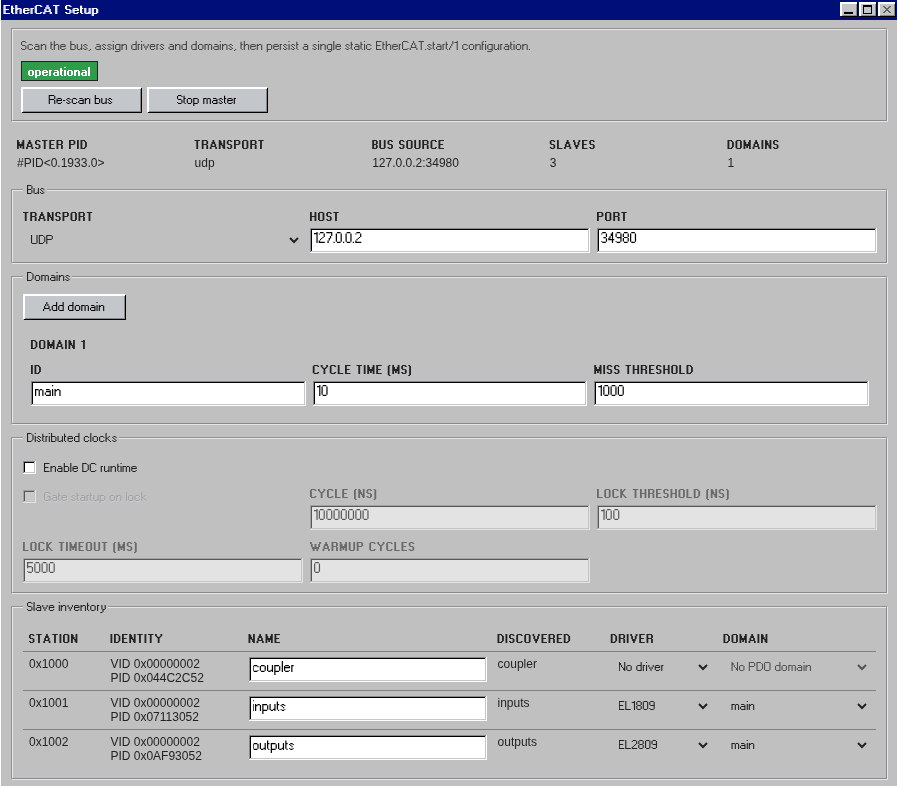
kino_ethercat gives you an
interactive UI for ring discovery, I/O control, and diagnostics.
Use EtherCAT.Simulator to drive the real master against a simulated ring.
That is the fastest way to exercise startup, mailbox, recovery, and fault
handling without a physical EtherCAT stack on your desk.
The repo ships maintained hardware scripts under examples/.
Recommended first stops:
examples/scan.exsexamples/diag.exsexamples/wiring_map.exsexamples/dc_sync.exsexamples/fault_tolerance.exs
ARCHITECTURE.mdfor subsystem boundaries and data flowhexdocs.pm/ethercatfor the API reference